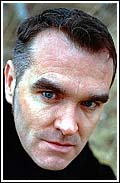
 Park
City, USA - "The Smiths were a nail in the eye of the pop industry. We only
followed our instincts. We played music in a very economical way and dressed in rags, my
voice was bare. I did sing incredibly straight, to the point and we were always
troublesome. The Smiths will always be there in my heart," says Steven Patrick
Morrissey about the love story that burst. He is now touring alone. In the beginning of
December, he’ll come to Sweden. Park
City, USA - "The Smiths were a nail in the eye of the pop industry. We only
followed our instincts. We played music in a very economical way and dressed in rags, my
voice was bare. I did sing incredibly straight, to the point and we were always
troublesome. The Smiths will always be there in my heart," says Steven Patrick
Morrissey about the love story that burst. He is now touring alone. In the beginning of
December, he’ll come to Sweden.
The group the Smiths made the individualist Morrissey one of the greatest characters in
the history of pop music, with strains of Oscar Wilde, James Dean and Lars Nor�n. His inverted voice, literary
brilliance and black humour, was crossed with Johnny Marr’s ingenious guitar
melodies.
It wasn’t just the Oasis-star Noel Gallagher that appreciated Smiths singles.
Millions of other starving souls were consoled by perhaps the greatest songwriting couple
in pop history since Lennon & McCartney. The songs were catchy, provoking and
intelligent in the early years of the 80’s, a time dominated by bizarre synthlads.
Morrissey sang about loneliness, weariness and impossible love when the new romantics
avoided the dull everyday life.
Now, ten years after the greatest band of the 80’s split up, he is touring the USA as
Morrissey. To meet him in Park City, the "Twin Peaks" of Utah is completely
surrealistic. It’s 45 minutes of car driving to the Mormon city of Salt Lake City,
far away from Los Angeles, and light years away from the gloomy working-class suburbs of
Manchester, where he grew up.
While waiting for his next gig, he has checked in at Stein
Eriksen’s kitschy hotel, among reindeer statues, conference people and newly rich
skiers. Surroundings correspond to the singer’s taste for the bizarre. In an
expensive Gucci coat he willingly poses in front of the camera, like an old circus-horse.
"The Smiths’ independent sound was never popular during the lifetime of the
band. But today, everybody wants to be alternative, REM, Alanis Morissette and so on. But
I haven’t been able to benefit from all that, I’m still outside the
outside," he says without sounding dissatisfied.
His critics smile at his composed case records and call the music
"miserabalism". He wants to be "Manchester’s answer to the
H-bomb". "That thing ‘miserabalism’ is just a big lie. People say
‘if you’re depressed; listen to Morrissey’s gothic, gloomy music.’
Just look at my audience, they are very healthy and are not gloomy people. They just want
to listen to a human voice, and that’s me," Morrissey says.
While artists like Bowie and Madonna have made a career
on changing their look, Moz is always Moz. The thick rockabilly hairdo is certainly
dressed, he has got a powdering of grey in his hair but he is still naming his songs with
such titles as "Trouble Loves Me" and "Satan Rejected My Soul". But
the fact is that he seems happier than Oasis and the British royal family altogether.
"Well, for me everything is getting better as the years pass. And it’s rather
fun being an Englishman, isn’t it? I still feel very English, despite the fact that
England is an internationalized country. But I try to avoid modern influences. I’m
one of those boring ones who wants London to remain London, England to remain England. But
that’s not a popular opinion."
His voice is soft and it doesn’t sound as strained as when he is singing. "It
wasn’t Hitler who destroyed the British architecture, it was ourselves."
Morrissey certainly loves Los Angeles, but he is dreaming of the lost England, which no
longer exists. An England, which ironically, disappeared at the same time he was born.
"But it’s really not only me. The Englishness is indeed an incredibly strong
identity. Artistically as well, England is a fantastically strong place, which is more
than you can say about most other countries. There, it’s like they are waiting for
someone else to do it. England did it. England was that ‘someone else.’"
"And surely, England is full of bullies as well, who are trying to place themselves
over the rest of the world, by being superior... but that’s alright," he says
and laughs. "The Fiji-islands need England, Wales needs to be a part of England -
because if it wasn’t - only God knows what could happen," he says wrinkles his
lips and smiles. He likes his cryptic statements, his little sarcasms and his own
mysticism. Yet he has dropped his guard and is in a pure confessional mood. "As you
know, I’m used to not being able to trust anyone. It has been quite a long and rough
journey. I am flattered by the fact that there is a myth about me, but I live a very
simple life. Everybody thinks that my experiences are more interesting than others...
(Pause for the sake of effect) ...And God should be aware that they’re absolutely
right. I am one big exaggeration," he says and guffaws.
Sure, the man is a contradiction: an English international playboy, snobbish
working-class, subversive patriot, romantic cynic, aggressive and soft, rude and
sophisticated, peaceful - but fascinated by violence at a distance. In addition he
doesn’t seem to make any difference out of women and men. Morrissey’s lyrics are
loaded with sexual ambivalence, with homoerotic undertones. In Morrissey’s life
sexuality is pushed out of its place. He says that he has hardly had sex, and definitely
nothing good. Principally he is celibate, nothing he recommends. "That’s just
the way it is, some things are placed so deep that you can’t reach them." He
gives few clues to his past; never talks about his dad, but sometimes he visits his mother
in Manchester.
Therapy hasn’t helped him very much. Morrissey needs his unsuccessful childhood as
well, to be the perfect patient. In his songs he is oscillating wildly between pathetic
self-pity and a capacity for heaving the beauty of sorrow. In the Smiths song "There
Is A Light That Never Goes Out", a car accident becomes a happy ending to an unhappy
love story. "I’m only attracted to the things I never can become or get. My pop
career would be finished if I found total harmony. You can’t get everything. My life
hasn’t been that bad. It would have been more tragic if I still had been alone in
some terrible bedroom somewhere. But popular music saved me, and that’s a perfect
substitute for love relationships."
Mostly he is listening to typical British pop from the 60’s, 70’s and the
80’s, soul singles and rockabilly. "Today’s popular music is no forum for
sensitivity and deeper thoughts, everything is brutalised. And I guess that Oasis is the
tip of the iceberg." The fact that he is sounding more tough on stage, he blames on
electronic dance music that changed the musical climate. "A live appearance has to be
very demonstrative. People want a kick, they want to let loose. And I’m both
fascinated and touched by the fact that they want to knock down the stage, want to throw
themselves violently, want to touch me. That’s more than you can say of the Rolling
Stones. I was shocked when I watched them on TV. Nothing happened, nobody wanted to touch
the Stones. And they themselves are of course absurd: Jagger imitating Jagger and the rest
of them looking like they were buried 12 years ago. The Rolling Stones are an after-death
experience, the ultimate freak-show. They should be locked in cages at a circus, being fed
with bananas, and covered by a blanket at night."
He has never tried to curry favour with his pop colleagues, and hardly ever wants to go to
his own release parties. "I must confess that I’ve never wanted to be in the
gang. I dislike backthumps and I am not able to say sweet things about pop colleagues,
only because you’ve met in some hotel lobby. I prefer saying mean things about people
I like" (laugh).
He will never be able to forgive the NME, for accusing him of being a racist, due to his
turbid patriotic statements, nor did like that he wrapped himself in the Union Jack and
flirted with skinhead symbolism. The NME attacked him for writing the song "National
Front Disco", from the record Your Arsenal where Morrissey sings about a young
man who loses himself to the dark forces of the right-extremism. "I’ve never
been a racist, and will never be. I can’t. I am to intelligent being a racist.
"National Front Disco" is not a racist song and nobody I’ve met thinks
that. Worse is that a lot at NME thought that. They wanted to assassinated me."
Football gives him greater kicks than both sex and the British press. Even if it’s
hard to follow Man U in the out-of-the way spots of Utah. "But football is actually
one of those things that make you shiver, an out-of-the-body feeling, that makes me float
in a very childish way. If I have an ambition, that is being more interested in sports, I
think it’s fantastic," Morrissey says, who is longing for the World
Championships in France 1998.
But he is also critical. "It has become so trendy, loving football, everybody writes
football books and make football movies. Suddenly I meet people who are trying to be
sophisticated pop-musicologians and talk about ‘the scent of grass.’"
"England is also full of rich people, trying to make a gimmick out of being
working-class, especially in pop music, which is supposed to originally come from the
gutter. Suddenly everyone should want to prove that they have a down-to-earth soul and
belong to the people. Then next year when the fashion changes, everyone will be waxing
their limousines and talking about Jean Genet again. I was
non-working class myself, trying to become working-class (laugh). Although I have money
nowadays, I think everyday that somebody will come take everything away. Perhaps I
won’t live that long... I could go up in that ski lift tomorrow and Bang! the chain
breaks."
That would be shame, when old Moz slowly starts to grow up.
|
